The Price of the Presumption of Innocence: What Happened When States Stopped Selling Freedom
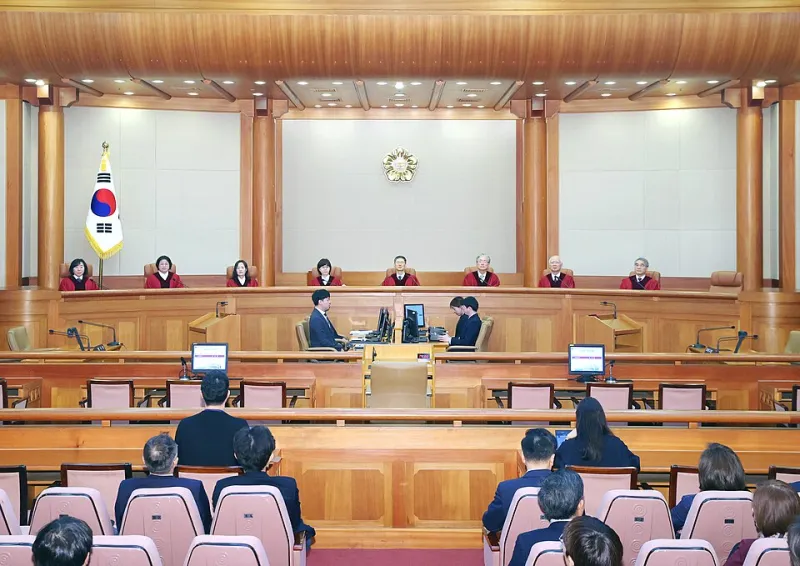
Photo: Constitutional Court of Korea, Attribution, via Wikimedia Commons
Every day in American courtrooms, judges perform a ritual that would be unrecognizable in almost any other context of public life: they announce whether a person accused of a crime — not convicted, accused — can afford to go home. If the answer is no, that person stays in a cell, sometimes for months, before ever seeing a trial.
We do not accept pay-to-play arrangements in medicine or education without protest. Yet in the criminal legal system, freedom itself has long carried a price tag. Cash bail is not a footnote to mass incarceration. It is a front door.
A Two-Tiered System of Justice
The mechanics are deceptively simple. A judge sets a dollar amount; a defendant either pays a bondsman, typically a nonrefundable 10 percent fee, or waits in jail. Someone facing a $10,000 bail needs $1,000 they almost certainly do not have. The result is a system that sorts people not by risk, not by the strength of the evidence, but by the contents of their bank account and the willingness of family members to drain theirs.
The consequences compound quickly. Research from the Pretrial Justice Institute and others has shown that even a few days in jail before trial increases the likelihood of losing a job, losing housing, losing custody of children, and accepting a plea just to get out. Innocent people plead guilty because the alternative is a cage. That is not justice; it is coercion with a courthouse attached.
And like nearly every mechanism in the carceral system, the burden falls along racial lines. Black defendants receive higher bail amounts than white defendants charged with similar offenses, a disparity documented across jurisdictions and decades.
New Jersey's Quiet Revolution
In 2017, New Jersey did something remarkable: it largely stopped using money to decide who waits at home and who waits in jail. A risk assessment tool and a system of pretrial detention hearings replaced cash bail for most cases.
The results have been studied exhaustively, and they puncture the fear-mongering that dominates bail debates. The state's jail population fell substantially. Court appearance rates held steady. Violent crime continued its long decline. New Jersey also eliminated its commercial bail bond industry almost entirely, redirecting money that once flowed to bondsmen out of the equation altogether.
Illinois followed in 2023 with the Pretrial Fairness Act, the first statewide abolition of cash bail in the nation. Early data from court systems across the state showed no spike in crime attributable to the change — only fewer people sitting in jail because they were poor.
The Backlash Machine
None of this happened without a fight, and the fight is not over. Illinois's reform survived a legal challenge and a ferocious legislative campaign before taking effect. In other states, reformers have faced referenda, legislative rollbacks, and a familiar political playbook that brands any pretrial reform as 'catch and release.'
The pattern is well-worn. Opponents seize on a single tragic case, blame the reform, and demand reversal — regardless of what the data shows. It is the same dynamic that fueled three decades of 'tough on crime' legislation, and advocates should treat it with the seriousness it deserves. Reform is not self-sustaining. It must be defended with the same organizing energy that won it.
Why This Is an Economic Justice Fight
It is tempting to frame bail as a criminal justice issue and stop there. That framing understates the stakes. Cash bail is a wealth-extraction mechanism. Bondsmen collect hundreds of millions of dollars annually, much of it from Black and brown families, much of it nonrefundable even when charges are dropped. Add lost wages, lost jobs, and the costs of jailing people who pose no danger, and the ledger becomes indefensible.
A system that cages people for being poor while the wealthy walk free is not a broken version of American justice. It is American justice working exactly as designed — and exactly as its post-Reconstruction architects intended.
The presumption of innocence should not be a luxury good. New Jersey and Illinois have shown that a different model works. The task now is to defend those gains, replicate them, and finish the job.