From Hallway Handcuffs to Cell Blocks: The Arithmetic of a Suspended Childhood
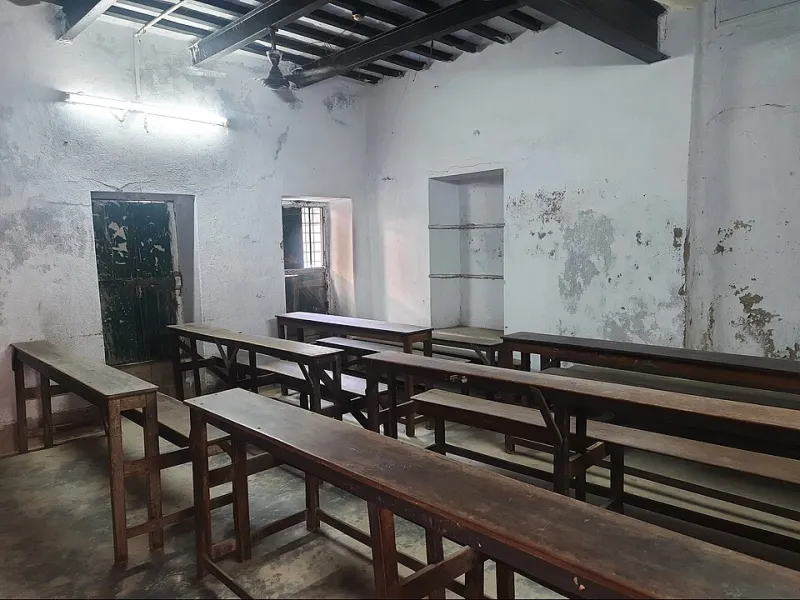
Photo: Sumita Roy Dutta, CC BY-SA 4.0, via Wikimedia Commons
The paperwork is unremarkable. A discipline referral, a suspension notice, sometimes an arrest citation filed by an officer stationed on campus. But researchers who have followed students across decades now describe these documents in blunter terms: they are the earliest invoices a child will ever receive from the carceral state.
The connection between exclusionary school discipline and eventual incarceration is no longer a hypothesis. It is one of the most consistently replicated findings in education research, and it maps onto race with a precision that should unsettle anyone who believes the criminal legal system merely responds to crime rather than manufacturing its own future clientele.
The Data Doesn't Whisper
Consider the trajectory documented across multiple longitudinal studies. Students suspended even once during middle school are roughly three times more likely to have contact with the juvenile justice system within the following year. Students suspended multiple times face dramatically elevated odds of dropping out—and dropping out, in turn, is among the strongest predictors of later incarceration.
Now layer race on top. Black students in American public schools are suspended at nearly four times the rate of their white classmates, and the disparity begins before kindergarten. Black children represent a minority of preschool enrollment but account for roughly half of preschool suspensions. The disparities hold after controlling for the behavior that allegedly triggered the discipline: in study after study, Black students receive harsher consequences for the same infractions.
Economists have a term for what happens next. When a child is pushed out of the classroom, the costs don't disappear—they are transferred. Lost instructional time becomes lost wages in adulthood. A disciplinary file becomes a criminal file. The suspension slip, in this light, is not a correction. It is a down payment.
Officers in the Corridors
None of this machinery runs itself. It requires personnel, and since the 1990s, schools have hired it in uniform.
The federal COPS in Schools program, launched in 1999, funneled hundreds of millions of dollars into placing sworn law enforcement officers on campuses. The rationale was safety. The consequence was criminalization. Behaviors that once meant a trip to the dean's office—talking back, a shoving match, a vape in a backpack—increasingly meant citations and court dates. Texas became emblematic of the problem: a landmark 2011 study from the Council of State Governments found that nearly a third of Texas students were suspended or expelled at some point, and that those students were far more likely to be arrested or drop out, with Black and Latino students disproportionately swept in.
Critics of school policing point to a bitter irony: the districts that spent millions on officers often lacked the funds for school counselors, nurses, or psychologists. The security budget grew while the support budget starved. Students didn't get help; they got handcuffs.
What Happens When Districts Choose Differently
The counterexamples are the reason this article is not simply a eulogy.
Clayton County, Georgia, remains the most cited case. In the early 2000s, juvenile court judge Steven Teske confronted a courtroom drowning in school-based arrests—most for minor offenses like fighting or disorderly conduct. His response was a cooperative agreement between the court, the district, and law enforcement: students committing minor infractions would face restorative interventions before any referral to juvenile court. Within a few years, school arrests fell by more than 80 percent. Graduation rates rose. Juvenile crime did not.
Broward County, Florida, followed a similar path in 2013, after the school-to-prison pipeline data in its own district became impossible to ignore. Its collaborative agreement sharply curtailed arrests for nonviolent misconduct in favor of mediation and mentoring. Campus arrests collapsed from over a thousand a year to a fraction of that figure—without the predicted wave of chaos.
Denver took a different route, negotiating a landmark 2013 agreement that sharply limited the role of police in its schools, and in 2020 the school board voted to end its contract with the police department entirely, redirecting resources toward mental health support. Minneapolis, Oakland, and Portland made similar commitments in the wake of 2020's racial justice uprisings.
The pattern across these districts is consistent: when schools stop calling the police on children, the sky does not fall. Attendance improves. Graduation rates climb. And the students who would have collected their first arrest citation at fourteen instead get to keep a clean record—the single most valuable document a young person can carry into the labor market.
The Economic Case Hiding Inside the Moral One
For readers of this site, the equity argument is familiar. But the economic argument deserves equal weight, because it speaks to constituencies that moral appeals have never moved.
Each year of schooling a student completes raises lifetime earnings measurably. Each suspension lowers them. The National Bureau of Economic Research and allied researchers have tied exclusionary discipline to reduced employment, lower wages, and increased likelihood of incarceration—all of which translate into lost tax revenue, higher social service costs, and a thinner labor force. Mass incarceration, we have argued on these pages for years, is not merely cruel; it is economically ruinous. The pipeline that feeds it begins in the same place: with policies that treat children as problems to be removed rather than assets to be developed.
A district that funds a restorative justice coordinator instead of a police contract is not making a soft-hearted choice. It is making a sound investment with a demonstrable return.
The Referral Is a Choice
There is no natural law requiring that a fourteen-year-old who talks back to a teacher be formally arrested. Every link in the chain—from the officer stationed in the hallway, to the citation, to the court date, to the record that follows a young person into adulthood—was assembled by human beings and can be disassembled by them.
The districts that have done so were not wealthier, gentler, or less burdened than their peers. They simply decided that a child's future was worth more than the comfort of a punitive habit. The data they generated in the process now stands as evidence for every district still hesitating: the pipeline can be shut off at the source, and the first place to start is the phone call home.
If your school district still stations police officers in its hallways, the numbers are on your side. Show them the arithmetic.